He Just Wanted to Stop His Wife From Bleeding — And Accidentally Created a Medical Icon
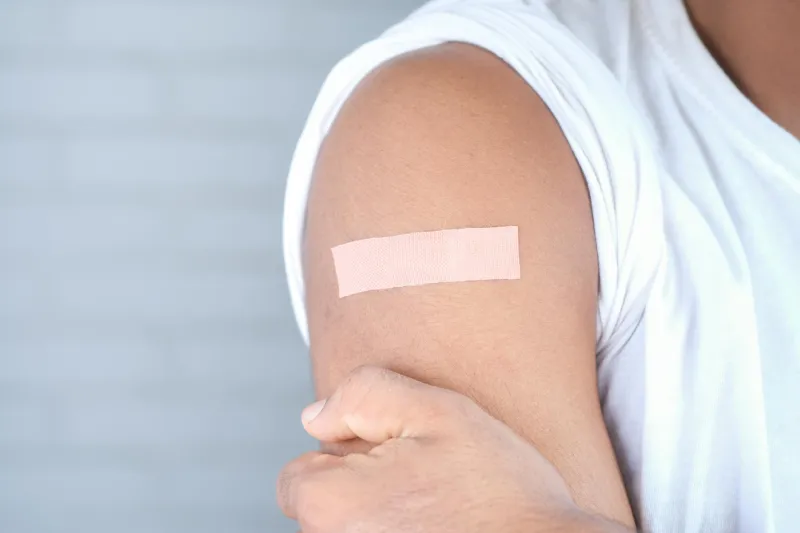
He Just Wanted to Stop His Wife From Bleeding — And Accidentally Created a Medical Icon
Most billion-dollar inventions start with a eureka moment in a lab, a boardroom pitch, or years of deliberate research. The Band-Aid started with a clumsy wife and a husband who was tired of playing nurse.
The year was 1920. Earle Dickson was a cotton buyer for Johnson & Johnson in New Brunswick, New Jersey — a quiet, methodical man whose job was about as far from medical innovation as you could get. His wife, Josephine, was enthusiastic in the kitchen but, by most accounts, accident-prone. Cuts, burns, nicks — she collected them the way some people collect stamps. And in the days before urgent care clinics and drugstore first-aid aisles, treating a minor wound meant hunting down surgical tape, cutting gauze, and fumbling through a clumsy bandaging process that required two hands and a fair amount of patience.
Josephine usually had neither.
A Kitchen Problem With a Simple Fix
Earle started thinking about the problem the way an engineer might — not dramatically, just practically. He took a long strip of Johnson & Johnson's surgical adhesive tape and placed small squares of sterile cotton gauze down the center at regular intervals. Then he covered the whole thing with crinoline fabric to keep it clean until it was needed. When Josephine hurt herself — and she would — she could tear off a piece, peel back the crinoline, and apply it herself. No scissors, no fumbling, no calling for help.
It was a remarkably simple idea. So simple that Earle almost didn't mention it to anyone at work.
But he did. He showed his homemade bandage strips to James Johnson, one of the company's executives, and Johnson saw something Earle hadn't fully considered: this wasn't just a fix for one clumsy housewife. This was a product every household in America could use.
Johnson & Johnson Almost Gave Up on It
The company moved quickly to manufacture the Band-Aid — a name coined by one of Johnson & Johnson's production superintendents — but early sales were painfully slow. The first strips were handmade, awkward to produce, and a full eighteen inches long. Consumers weren't sure what to make of them. In 1921, the company sold just $3,000 worth of the product. By any measure, it looked like a flop.
But Johnson & Johnson didn't pull the plug. Instead, they did something that would become a masterclass in product seeding: they gave Band-Aids away for free. Boxes went to Boy Scout troops across the country. Soldiers received them. The idea was to get the product into people's hands — literally — and let it prove its own usefulness.
It worked. Once people used a Band-Aid, they didn't want to go back to the old method. By the mid-1920s, sales were climbing. By the end of the decade, the Band-Aid had become a fixture in American medicine cabinets.
The Design That Refused to Change
What's remarkable about the Band-Aid isn't just how it was born — it's how little it has changed since. The core concept Earle Dickson sketched out in his kitchen in 1920 is essentially the same one you find in the box today: an adhesive strip with a sterile pad in the center, protected by a peel-away cover. The materials have improved. The shapes have multiplied. There are waterproof versions, fabric versions, clear versions, and — in a nod to twenty-first century branding — ones featuring cartoon characters. But the fundamental design? Untouched.
That's not an accident. It's a sign that Earle Dickson got it right the first time.
Over the decades, the Band-Aid became something more than a medical product. It became a cultural shorthand — a symbol of minor suffering, quick fixes, and the particular comfort of feeling taken care of. Americans started using the word as a verb ('just Band-Aid it') and as a metaphor for anything that patches a problem without fully solving it. That kind of cultural absorption is rare. It happens when a product is so useful, so familiar, and so perfectly designed that it stops being a thing and becomes an idea.
What Happened to Earle?
For his invention, Earle Dickson was promoted to vice president at Johnson & Johnson — a remarkable rise for a man whose original motivation was simply to make life a little easier for his wife. He stayed with the company for the rest of his career.
Josephine, for her part, presumably kept cutting herself in the kitchen. But at least she had a better solution.
Today, Johnson & Johnson sells more than a billion Band-Aid units every year. The product has been manufactured in dozens of countries and has inspired countless imitators — though none have managed to knock the original from its spot at the top of the first-aid drawer.
All of it traces back to a man who looked at a recurring household problem and thought: there has to be a simpler way. He wasn't trying to change medicine. He wasn't chasing a patent or a promotion. He was just trying to help the person he loved get through the day with fewer injuries.
Sometimes the most enduring inventions are the ones that start that small.