Gold Rush Dropout: The Unlikely Accident That Gave America Its Favorite Pants
Gold Rush Dropout: The Unlikely Accident That Gave America Its Favorite Pants
Right now, there's a decent chance you're wearing them. Or you wore them yesterday. Or you'll throw them on tomorrow without giving it a second thought. Blue jeans are so woven into American life that they barely register as a choice anymore — they're just there, like pickup trucks and peanut butter.
But here's what almost nobody knows: the man who made them famous didn't come to California to sell pants. He came to get rich. And when that didn't work out, he stumbled into something far bigger.
The Man Behind the Myth
Levi Strauss was a 24-year-old Bavarian immigrant when he landed in San Francisco in 1853 — four years into the California Gold Rush. He wasn't there to pan for gold himself. He was a dry goods merchant, and he came to sell supplies to the thousands of men who were. Canvas, thread, blankets, fabric — the stuff that keeps a mining camp running.
His business did reasonably well. He opened a wholesale operation, built a reputation, and spent the next two decades quietly supplying the booming West. Not glamorous, but solid. What he did not do, at least not yet, was change the course of American clothing.
That part came later — and it came from a letter.
A Tailor With a Problem
In 1872, a Nevada tailor named Jacob Davis wrote to Strauss with an unusual pitch. Davis had been making work pants for laborers — miners, farmers, ranchers — and he'd noticed that the seams and pockets kept blowing out under heavy use. So he started reinforcing the stress points with small copper rivets, the same kind used on horse blankets. The pants held up dramatically better, and word spread fast.
Davis wanted to patent the idea, but he didn't have the $68 filing fee. So he offered Strauss a deal: cover the cost, split the patent, and manufacture the riveted pants at scale.
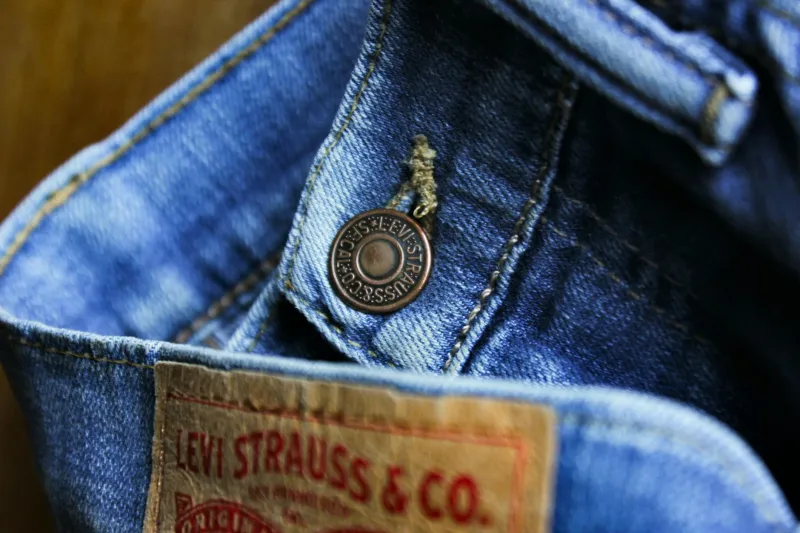
Strauss said yes. On May 20, 1873, U.S. Patent No. 139,121 was granted for "Improvement in Fastening Pocket-Openings" — and the blue jean as we know it was officially born.
Built for Punishment, Not Fashion
Those early Levi's were nothing like what you'd pull off a rack today. They were made from denim — a durable twill fabric that had been imported from Nîmes, France (the word denim is thought to come from "de Nîmes," meaning "from Nîmes"). The color was an indigo blue because that dye was cheap, widely available, and didn't show dirt the way lighter colors did.
The design was purely functional. Double-stitched seams. Riveted pockets. A watch pocket stitched into the waistband. No stretch, no style, no frills. These were pants engineered to withstand 12-hour shifts in mine shafts and wheat fields. The idea that someone would wear them to a dinner party or a first date would have seemed completely absurd.
For the next several decades, that's exactly what they were: workwear. Farmers wore them. Cowboys wore them. Laborers wore them. Nobody else paid much attention.
Hollywood Changed Everything
The leap from the fields to the mainstream happened slowly — and then all at once.
In the 1930s and 1940s, Hollywood Westerns started dressing their heroes in denim. John Wayne. Gary Cooper. Gene Autry. Suddenly, blue jeans weren't just the clothes of hard labor — they were the clothes of rugged, romanticized American manhood. The cowboy became a cultural icon, and his pants came along for the ride.
But the real tipping point came after World War II. Returning veterans had spent years in uniform, and a generation of young Americans was hungry for something that felt free. Jeans — previously associated with working-class toughness — became a symbol of rebellion. James Dean wore them in Rebel Without a Cause in 1955. Marlon Brando wore them in The Wild One. Teenagers adopted them almost overnight, and parents, predictably, were horrified.
Some schools banned them outright. That, of course, only made them cooler.
From Rebellion to Religion
By the 1960s, jeans had crossed every cultural line imaginable. College students wore them to protests. Rock musicians wore them on stage. Eventually, designers got involved — in 1978, Gloria Vanderbilt put her name on a pair of fitted jeans and sold 200,000 in the first week. The workwear had officially become fashion.
Today, the global denim market is worth over $60 billion. Levi's alone sells in more than 110 countries. A pair of original 1800s Levi's sold at auction in 2022 for $76,000.
Jacob Davis, the Nevada tailor who just wanted to stop pockets from tearing, probably couldn't have imagined any of it. Neither could Levi Strauss, who was really just trying to move some dry goods in a Gold Rush town and make a decent living.
That's the thing about accidental inventions. Nobody sets out to make an icon. They just try to solve a problem — and sometimes, the solution outlasts everything else.