The Watch Pocket That Outlived the Watch by 150 Years
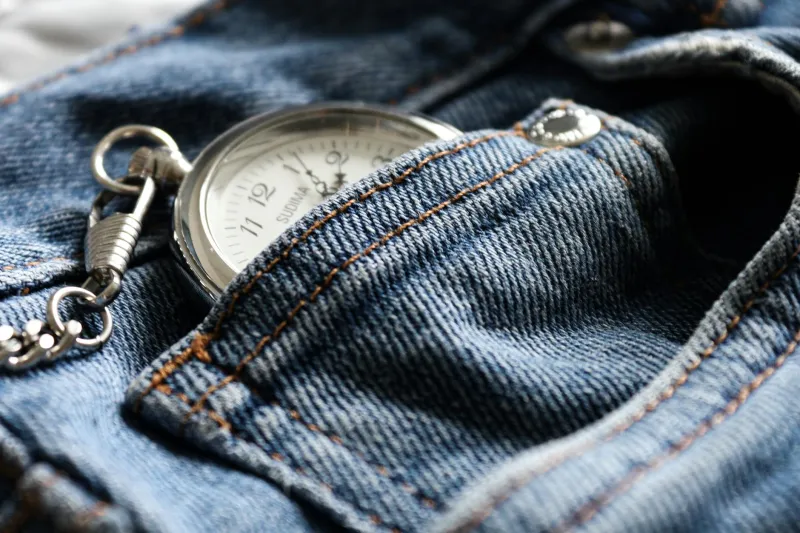
The Pocket That Time Forgot
Reach into the front pocket of any pair of jeans and you'll find it—that impossibly small fifth pocket that seems designed for nothing useful in modern life. Too small for your phone, too shallow for coins, too narrow for keys. Yet there it sits, stitched into every pair of denim pants sold in America, from designer brands to discount store basics.
Most people call it a "coin pocket" and stuff loose change inside, but that's not what it was made for. This tiny pocket has a very specific origin story that takes us back to the American frontier, when cowboys carried one essential tool that modern Americans have completely abandoned.
When Every Man Carried Time in His Pocket
In 1873, when Jacob Davis and Levi Strauss patented their riveted work pants, pocket watches were as essential as smartphones are today. Every working man carried one, and losing it could mean losing your job. Railroad workers needed precise timing to avoid collisions. Miners tracked their shifts underground. Cowboys coordinated cattle drives across vast distances.
But pocket watches were delicate, expensive instruments that could easily be damaged by the rough work that denim pants were designed for. A watch bouncing around in a large pocket with tools, coins, and other gear would quickly become a broken watch.
Davis, the Nevada tailor who invented the rivet system, understood this problem. His original design included a small, protected pocket specifically sized for a standard pocket watch. The watch sat snugly inside, protected from damage but easily accessible when a worker needed to check the time.
The Perfect Fit for a Forgotten Tool
The dimensions of that original watch pocket weren't arbitrary. In the 1870s, most pocket watches measured about 2 inches in diameter and roughly half an inch thick. The small denim pocket was tailored to these exact measurements, creating a secure fit that kept the watch from rattling around while still allowing easy removal.
This wasn't just functional—it was essential. A cowboy's pocket watch might cost a month's wages, making it one of his most valuable possessions. The dedicated pocket meant he could carry his timepiece safely while still having full use of his main pockets for rope, tools, tobacco, and whatever else the job required.
Levi Strauss & Co. wasn't alone in this design choice. Other work pants manufacturers of the era included similar watch pockets, recognizing that their target customers—miners, railroad workers, farmers, and cowboys—all depended on pocket watches for their livelihoods.
When Watches Moved to Wrists
World War I changed everything. Soldiers needed to check time quickly while keeping their hands free for weapons and equipment. Wristwatches, previously considered feminine accessories, became military necessities. By the 1920s, American men had largely abandoned pocket watches in favor of wrist-worn timepieces.
Suddenly, that carefully designed watch pocket had lost its purpose. But by then, Levi's had been manufacturing jeans with the small pocket for nearly 50 years. The design had become part of their signature look, and changing it would have required retooling their entire manufacturing process.
More importantly, customers had grown attached to the pocket. Even without pocket watches, people found uses for the small space. Some carried coins, others tucked away small tools or personal items. The pocket had become part of the jeans experience, even if its original purpose was forgotten.
The Stubborn Survival of Obsolete Design
Levi Strauss & Co. made a business decision that would echo through fashion history: they kept the watch pocket. When other denim manufacturers started copying the Levi's design in the mid-20th century, they copied everything, including the mysterious small pocket that no longer served its original function.
This created a fascinating example of design persistence. The watch pocket became a standard feature of American jeans not because it was useful, but because it had always been there. Removing it would have made jeans look "wrong" to customers who expected to see five pockets, even if they couldn't explain why.
Jeans manufacturers occasionally experimented with eliminating the watch pocket, but customer complaints always brought it back. The pocket had become part of the visual DNA of denim pants, as essential to the design as rivets or the distinctive stitching pattern.
From Function to Fashion Fossil
Today's watch pocket is a perfect example of what designers call a "skeuomorphic" feature—an element that mimics something from an earlier technology even when that technology is obsolete. Like the floppy disk icon for "save" on computers, the watch pocket persists because it's become part of our visual vocabulary.
Modern jeans wearers have invented new uses for the space. Some store guitar picks, others keep emergency cash or medication. The rise of small electronic devices has given the pocket new relevance—it's perfectly sized for earbuds, USB drives, or even small vaping devices.
But these modern uses are accidents of size, not intention. The pocket remains exactly the same dimensions it was in 1873, designed for a tool that most Americans have never owned.
The Pocket That Won't Die
Every major denim brand continues to include the watch pocket in their designs. Designer jeans selling for hundreds of dollars feature the same small pocket as discount store basics. It's become one of fashion's most enduring mysteries—a functional feature that outlived its function by more than a century.
The next time you slide your fingers into that tiny pocket, you're touching a piece of American frontier history. That small space once held the most important tool a working man could carry. Today, it's a fashion fossil that connects modern jeans to their cowboy origins, preserved in denim amber for reasons that even the manufacturers can't fully explain.
Some design elements transcend their original purpose to become cultural touchstones. The watch pocket is denim's most persistent ghost—the shadow of a tool that shaped the American West, still stitched into the pants that shaped American fashion.