The 15-Minute Pause That Rewired the American Workplace
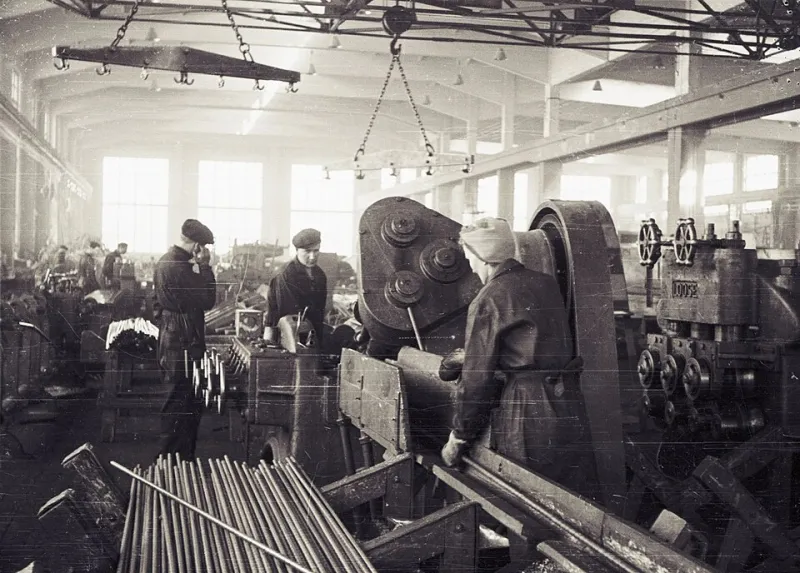
Photo: Reino Kalevi Lehtonen, Public domain, via Wikimedia Commons
Nobody Gave You That Break Out of Kindness
At some point today, you probably stepped away from your desk, wandered toward the coffee machine, and spent a few minutes doing absolutely nothing useful. And if anyone questioned it, there's a reasonable chance you'd frame it as a right rather than a privilege.
That sense of entitlement isn't accidental. The American coffee break was engineered — first by efficiency experts trying to squeeze more output from factory workers, then by a coffee industry that recognized a golden marketing opportunity, and finally by labor culture that transformed a calculated management tool into something workers would eventually fight to protect.
The story of how a 15-minute pause became non-negotiable is a good reminder that the things we take for granted in daily life almost always have a stranger origin than we expect.
The Industrial Logic Behind Doing Nothing
In the early twentieth century, American factories were run on a philosophy of continuous output. The prevailing management theory, heavily influenced by Frederick Winslow Taylor's time-and-motion studies, held that any moment a worker wasn't actively producing was a moment being wasted. Breaks were a cost. Idle time was the enemy.
But cracks were appearing in that logic. Factory supervisors were noticing that workers who pushed through long shifts without interruption didn't actually produce more — they produced less, and with more errors, as fatigue set in. Output would spike in the morning, plateau by mid-morning, and then slide steadily through the afternoon.
The question some researchers began asking wasn't whether workers should rest. It was whether rest, strategically placed, could actually increase total output. The answer, as it turned out, was yes — and it came from some unexpected places.
What a Buffalo Candy Factory Figured Out First
One of the earliest and most cited experiments in scheduled rest breaks happened not in a laboratory but on the factory floor of the Binghamton, New York-based Larkin Soap Company — and later, more famously, at the Buffalo-based industrial operations studied by efficiency consultants in the 1900s and 1910s.
But the story that tends to get overlooked is the role of the Stacey's coffee experiment. In 1902, a small industrial operation in Stoughton, Wisconsin — a town with a large Norwegian immigrant workforce — began allowing women workers in a tobacco processing facility to take short coffee breaks in the morning. The women had been bringing coffee from home and drinking it during informal pauses anyway. Management decided to formalize it.
Productivity didn't drop. It went up. Workers returned to their stations more focused. Errors declined. The informal habit became a scheduled fixture, and Stoughton, Wisconsin still celebrates itself as the birthplace of the coffee break — hosting an annual festival in its honor.
The idea spread slowly at first, moving through industrial networks as more factory managers began experimenting with structured pauses. By the 1920s and 1930s, the concept had enough momentum to attract serious scientific attention.
When the Coffee Industry Got Involved
Here's where the story takes a sharp commercial turn.
By the late 1940s, coffee consumption in the United States was already high, but the industry was looking for ways to grow demand further. The Pan-American Coffee Bureau — a trade organization representing coffee-producing nations in South America — recognized that workplace breaks were a natural consumption opportunity. If they could make the coffee break a cultural institution rather than just an informal habit, they'd have a captive market of millions of workers drinking coffee at prescribed times every day.
In 1952, the Bureau launched a direct advertising campaign promoting the coffee break as a workplace right. They ran ads in newspapers and magazines with taglines urging American workers to "Give yourself a Coffee-Break." The campaign was targeted at both employees and employers — framing the break as good for morale, good for productivity, and good for business.
It worked remarkably well. Within a few years, the coffee break had shifted from an informal practice in some workplaces to something that felt like a standard expectation. Union contracts in the 1950s began explicitly including coffee break provisions. The break had gone from a management experiment to an employee entitlement in the space of a generation.
The Science That Made It Stick
What gave the coffee break its staying power wasn't just marketing or labor negotiation — it was the fact that the underlying productivity argument held up. Researchers studying workplace performance throughout the mid-twentieth century consistently found that brief, regular breaks improved concentration, reduced error rates, and lowered stress-related fatigue.
The specific timing mattered too. A mid-morning break — typically around 10 a.m. — aligned with a natural dip in human alertness that researchers would later connect to circadian rhythm patterns. The break wasn't interrupting peak performance. It was bridging a natural valley.
By the time neuroscience and cognitive psychology caught up in the 1990s and 2000s, the coffee break had been a fixture of American work life for decades. The new research simply confirmed what factory managers in Wisconsin had stumbled onto by accident: the human brain performs better in bursts, with recovery time built in.
From Factory Floor to Open-Plan Office
The modern coffee break has evolved considerably from its industrial origins. In today's workplace, the ritual is less structured — remote workers make their own coffee at home, office workers gather in kitchen areas or walk to nearby cafés, and the 15-minute window has become fluid enough to include a scroll through a phone or a quick walk around the block.
But the underlying logic remains identical to what efficiency experts were arguing in 1910: a short, intentional pause makes the time around it more productive. The pause isn't a retreat from work. It's a part of work.
The coffee industry understood that before most employers did. And the workers who fought to put break provisions into union contracts understood it before most managers wanted to admit it.
What started as a counterintuitive experiment in a tobacco factory is now baked into the rhythm of the American workday — and into the business models of every coffee chain from here to the coasts. Not bad for a 15-minute interruption.