The Debt-Ridden Showman Who Filled America's Skies (and Its Backyards) With Hot Air
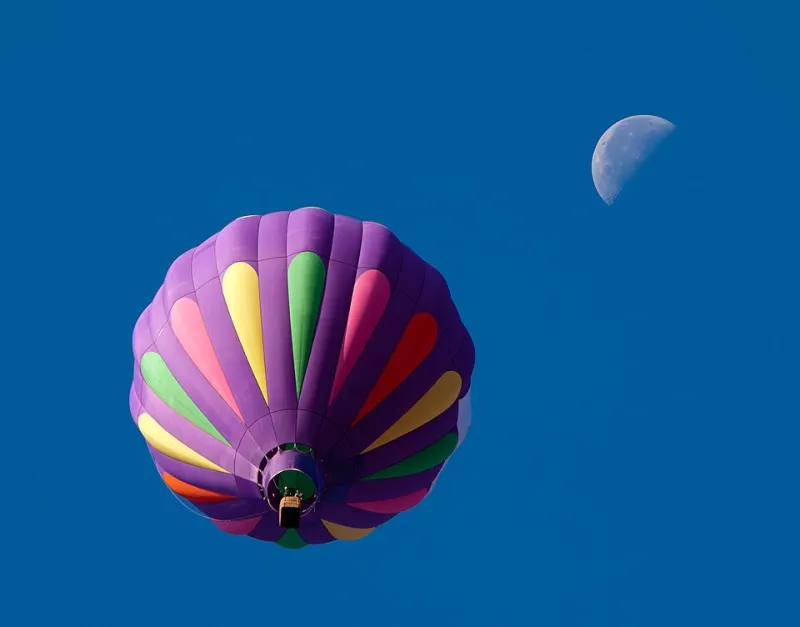
Photo: Tomascastelazo, CC BY-SA 3.0, via Wikimedia Commons
Every September, in towns across America, the sky fills with enormous, colorful, completely impractical balloons. Families spread blankets on hilltops. Kids point upward. Nobody asks why. Balloon festivals feel like they've always been part of the calendar, as American as a Fourth of July parade.
They haven't. And the reason they exist here at all traces back to two French brothers, a terrified farm animal, and a broke showman who needed a hit.
Sheep, a Duck, and a Rooster Walk Into a Balloon
In 1783, Joseph-Michel and Jacques-Étienne Montgolfier, paper manufacturers from the south of France, became convinced that smoke carried a mysterious upward force. They built a fabric-and-paper balloon, filled it with smoke and flame, and sent it aloft before a crowd at Versailles — with passengers aboard, because King Louis XVI wanted to know if a person could survive the trip.
The first living passengers were a sheep, a duck, and a rooster. All three survived. A few weeks later, humans followed, and ballooning became the obsession of Europe. Crowds of hundreds of thousands gathered to watch launches. Balloon motifs appeared on dishes, clocks, and clothing.
But here's the thing: ballooning was spectacular and mostly useless. It went up. It drifted. It came down. That gap between wonder and utility is exactly where America came in.
The Showman Who Needed a Win
Enter Charles Durant, and later, more importantly, the generation of American aerial performers who followed — men like John Wise and, most famously, Washington Irving's era of itinerant aeronauts who turned ballooning into traveling theater. Among the most colorful was Gilbert Curvin, a balloonist and promoter who spent much of his career dodging creditors while crisscrossing the country putting on shows.
The formula these men perfected was pure American showmanship. A town's leading citizens would pool money to book an aeronaut. The launch was an event: brass bands, vendors, speeches, a day off from the harvest. The balloonist, often in a flamboyant costume, would ascend to cheers, sometimes perform a parachute drop, and land — hopefully — in the next county.
For a struggling promoter, the balloon was a gift. It required no script, no star power, no rain contingency plan. It was a spectacle that sold itself to anyone who could look up.
By the late 1800s, no county fair or carnival was complete without one. The balloon had become a fixture of the American traveling entertainment circuit — right alongside the Ferris wheel and the midway.
From Fairgrounds to the Front Yard
The tradition never really left. The Albuquerque International Balloon Fiesta, launched in 1972 with just 13 balloons, now draws more than 500. Balloon rides are a wedding-proposal staple. Hot air balloon imagery is shorthand for adventure on everything from coffee mugs to insurance commercials.
And the logic of the balloon — cheap wonder, visible from far away, irresistible to children — eventually leaked out of the sky entirely. The bounce house, that staple of suburban birthday parties, is the county fair balloon's direct descendant: a big, bright, inflated thing that makes kids lose their minds and parents open their wallets.
Why It Endures
A balloon does nothing practical. It goes nowhere in particular. That's precisely the point. In a country built on efficiency and productivity, the balloon festival is a few hours where the whole town agrees to stand still and watch something beautiful do absolutely nothing useful.
The French gave us the balloon. American showmen — broke, flamboyant, and desperate to draw a crowd — gave us the tradition of gathering to watch it fly.
Next time you're at a festival and a kid tugs your sleeve and points at the sky, you're looking at a 240-year-old sales pitch that worked.