The Longest Key on the Keyboard Has the Shortest Origin Story — Or Does It?
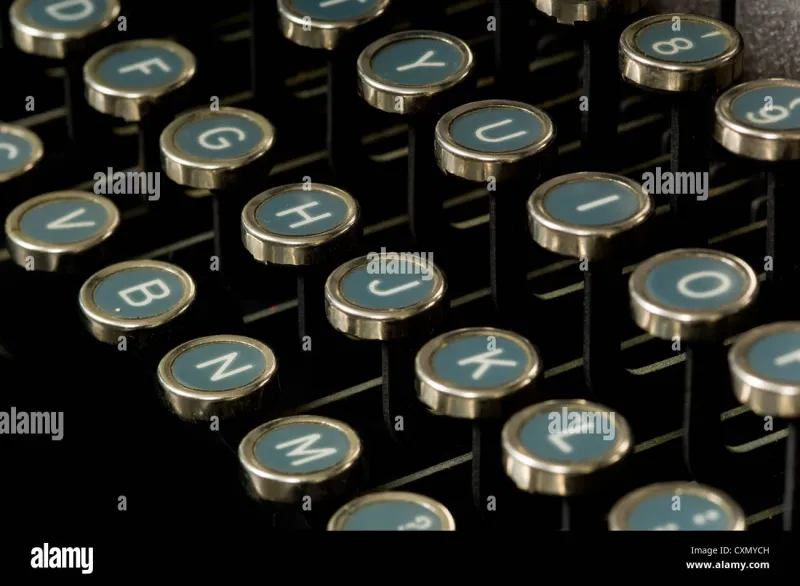
Photo: vintage typewriter keyboard close up keys detail, via c8.alamy.com
Hit it once between every word you type. Hit it after every period. Hit it to pause a video, jump in a video game, or confirm a selection. The space bar is the single most frequently pressed key on any keyboard — and it is almost certainly the one you've thought about the least.
It's just there. It always has been. Wide, flat, reliable, and completely invisible in the mental landscape of typing. Which is exactly what makes its origin story worth telling.
Before the Space Bar, There Was a Lever
The typewriter arrived in commercial form in the early 1870s, when the Sholes and Glidden machine — manufactured by Remington — went on sale to the American public in 1874. It was a remarkable device and an awkward one. Keys were stiff. The mechanism jammed frequently. And spacing between words was handled by a metal bar that had to be physically depressed to advance the carriage.
That bar wasn't called a space bar yet. Early documentation refers to it variously as the "space key," the "blank key," or simply the "spacing lever." It was functional but not elegant — a solution to a mechanical problem rather than a considered design feature.
Critically, early versions of the spacing mechanism were positioned differently on different machines. Some sat at the side of the keyboard. Some required a separate hand motion entirely. There was no standardization, and the physical effort required to advance the carriage between words was not trivial. Typing was exhausting work.
Who Was Actually Doing the Typing?
This is where the history gets more complicated — and more interesting.
In the 1870s and 1880s, typing was not yet the universal office skill it would become. The typewriter had been marketed initially toward writers, lawyers, and businessmen. But it was quickly discovered that operating one efficiently required dedicated practice — hours of drilling that most executives and professionals had no interest in investing.
The solution was to hire people specifically to type. And the people hired, overwhelmingly, were women.
By the 1880s, "typewriter" was becoming a job title as much as a machine name, and the majority of people filling that role were young women working in offices across American cities. The feminization of typing happened remarkably fast: by 1900, women made up about 77 percent of all typists in the United States.
This matters for the space bar's story because it was the professional typists — not the engineers, not the executives, not the inventors — who spent eight hours a day actually using the machine. They were the ones who felt every awkward key placement. They were the ones whose wrists ached from reaching for a poorly positioned spacing lever. Their feedback, filtered through supervisors and eventually to manufacturers, drove the ergonomic refinements that shaped the modern keyboard.
The Ergonomic Accident That Fixed Everything
The shift toward a wide, thumb-accessible horizontal bar at the base of the keyboard — the space bar as we now recognize it — emerged through a combination of competing manufacturer decisions during the 1880s and 1890s. Remington, Underwood, and other typewriter companies were locked in fierce commercial competition, each iterating on their designs to attract professional typists and the businesses that employed them.
The thumb placement was not an obvious choice. Early design logic might have placed the spacing key anywhere — to the side, at the top, operated by the pinky or the palm. What made the bottom-center position win out was its compatibility with natural hand position during typing: both thumbs hang naturally over that space when fingers rest on the home row keys.
That anatomical insight — that the thumb is largely idle during normal typing and ideally positioned to handle the most frequent non-letter action — is the quiet genius behind the space bar's placement. It reduced fatigue, increased speed, and made sustained typing physically manageable in a way that earlier configurations had not.
The women who typed for a living didn't design the space bar. But the commercial pressure to build machines that professional typists would prefer — and that employers would therefore buy — meant their physical experience shaped the outcome.
Why Her Name Isn't in the History Books
Typewriter history tends to celebrate inventors and industrialists: Christopher Latham Sholes, who developed the QWERTY layout; James Densmore, who financed it; E. Remington and Sons, who manufactured it. The names attached to keyboard history are almost exclusively male.
The women who refined it through daily use — who collectively logged more hours on these machines than any engineer — exist in the historical record mostly as statistics. We know they were there. We know their preferences drove purchasing decisions that shaped design. We don't know most of their names.
This isn't unusual in technology history. The people who build things tend to get credited. The people who use things, test things, and break things in instructive ways tend to get forgotten. With early typewriters, that invisible user base was largely female, and the historical record reflects who the era's chroniclers thought was worth naming.
From Mechanical Bar to Digital Default
When the first computer keyboards were designed in the 1960s and 1970s, engineers largely copied the layout of the electric typewriter. The space bar came along for the ride — same position, same thumb logic, same proportional width — because it worked, and because changing it would have required retraining every typist in America.
Today, the space bar on a standard keyboard is approximately four inches wide. It occupies more physical real estate than any other key. On a smartphone, it's the widest key on the virtual keyboard. In video game design, it's the default "jump" or "action" button precisely because it's the most naturally accessible key for a resting hand.
The longest key on the keyboard got its shape from the physical reality of human thumbs, the competitive pressure of a 19th-century typewriter market, and the daily experience of workers whose names history mostly didn't record.
Every time you hit it — and you'll hit it thousands of times today — that's the whole story compressed into a single, silent click.