The Throwaway Doodle That Taught the Internet How to Feel
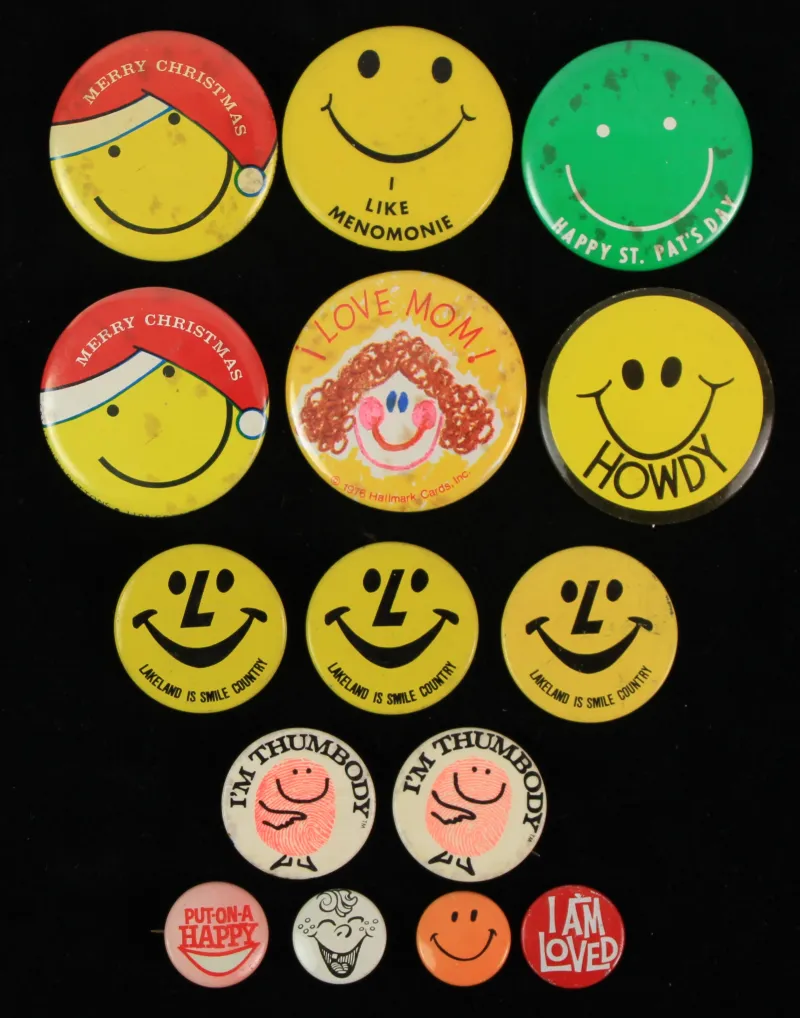
Photo: vintage yellow smiley face button 1970s close up, via www.mearsonlineauctions.com
There is a decent chance you used a smiley face today. Maybe it was the classic yellow emoji on your iPhone. Maybe it was a colon and a parenthesis typed at the end of a text. Either way, you used it to do something that written language has always struggled with: you told someone how you were actually feeling.
That ability — to inject emotion into flat, digital text — traces back to a single unremarkable afternoon in 1963, when a freelance designer named Harvey Ball spent about ten minutes sketching something he would never bother to trademark.
The $45 Commission That Started Everything
In the early 1960s, a Worcester, Massachusetts insurance company called State Mutual Life Assurance was going through a rocky merger. Employee morale had tanked. Management wanted a quick fix — something cheerful they could slap on buttons and promotional materials to remind their workforce that everything was fine.
They hired Harvey Ball, a local commercial artist, and gave him an open brief. Ball sat down, grabbed a sheet of paper, and drew a circle. He filled it yellow, added two oval eyes, and curved a line upward into a smile. He later said the whole thing took less than ten minutes. State Mutual paid him $45. No contract. No copyright. No royalties.
The buttons were a hit inside the company. And that, as far as Ball was concerned, was that.
When Two Brothers Turned a Smile Into a Brand
For nearly a decade, the image sat quietly in the world — printed on a few thousand insurance company buttons and not much else. Then, in 1970, two brothers from Philadelphia named Bernard and Murray Spain spotted the design, recognized something in its uncomplicated cheerfulness, and decided to build a business around it.
They added the phrase "Have a Happy Day" (later shortened to the now-iconic "Have a Nice Day"), trademarked the combination, and began licensing it aggressively. Within two years, the smiley face was everywhere — on posters, mugs, t-shirts, and greeting cards. An estimated 50 million smiley face buttons were sold in 1971 alone.
Harvey Ball, who had never filed for a copyright, received nothing from any of it. He later said he had no regrets, though he did eventually start World Smile Day in 1999 as a gentle, good-natured assertion of original authorship.
The Problem Nobody Had Named Yet
Fast forward to September 19, 1982. A computer science professor at Carnegie Mellon University named Scott Fahlman was monitoring an online bulletin board — the kind of early digital forum that preceded the modern internet — when he noticed a recurring problem.
People were posting jokes. Other people were reading them as serious statements. Arguments were breaking out over comments that were clearly meant to be lighthearted. The flat, toneless nature of typed text was causing real confusion, and there was no established way to signal sarcasm, humor, or warmth.
Fahlman proposed a solution in a now-famous post: use :-) to mark jokes, and :-( to mark serious or negative content. He didn't call it an emoticon. He didn't think it was a big deal. He just wanted to stop the arguments.
But something clicked. The idea spread rapidly across early internet communities, university networks, and eventually into mainstream digital communication. The sideways smiley face — built entirely from existing keyboard characters — had solved a problem that nobody had formally identified: how do you make emotion readable through a screen?
From Sideways Colons to a Global Visual Language
For years, emoticons lived as text: :-) and ;-) and :-D, little typographic performances that required the reader to tilt their head slightly to decode them. They were charming, slightly awkward, and deeply human.
Then, in 1999, a Japanese designer named Shigetaka Kurita working for NTT DoCoMo created the first true emoji — small, standardized pictograms designed for mobile phones. The word "emoji" comes from the Japanese for "picture character," and the original set of 176 icons included weather symbols, traffic signs, and yes, a smiley face.
Apple introduced emoji support to the iPhone in 2008, initially only in Japan. By 2011, they had unlocked the keyboard for American users, and adoption was almost instantaneous. Today, over 10 billion emojis are sent every single day across platforms worldwide.
The Oxford Dictionary named the "Face With Tears of Joy" emoji its Word of the Year in 2015 — a decision that annoyed a lot of linguists but accurately reflected how thoroughly visual emotion had infiltrated written communication.
Why a Yellow Circle Changed the Rules
What Harvey Ball drew in ten minutes and Scott Fahlman typed in a few keystrokes both addressed the same fundamental limitation of written language: it strips out tone. A letter, an email, a text message — none of them carry the micro-expressions and vocal inflections that tell us whether someone is delighted, sarcastic, or quietly furious.
The smiley face, in all its forms, became a patch for that gap. It let strangers signal goodwill. It let friends soften criticism. It let coworkers clarify that a blunt message wasn't meant to sting.
That's a remarkable amount of social work for a circle with a curve in it.
Harvey Ball died in 2001, still living in Worcester, still apparently unbothered by the fortune he had given away for $45. His original design — that ten-minute sketch — now lives in the permanent collection of the Smithsonian Institution.
Not bad for a throwaway doodle.