The Color That Ate Cloth
In 1873, when Jacob Davis and Levi Strauss patented their metal-riveted work pants, they faced a problem that had plagued textile manufacturers for centuries: indigo dye was completely unpredictable. One batch might produce a rich, lasting blue. The next might turn fabric purple, green, or simply dissolve the threads entirely.
 Photo: Levi Strauss, via komforts.net
 Photo: Jacob Davis, via www.stripspeciaalzaak.be
Textile workers called indigo "the devil's dye" because it seemed possessed by malevolent spirits. Entire shipments of fabric would emerge from dye vats as expensive rags. The chemical process was so unstable that many manufacturers refused to work with indigo at all, despite its popularity among consumers.
Yet this cursed colorant would eventually become so synonymous with American workwear that "blue collar" entered the language as shorthand for an entire social class.
The Ancient Chemistry Nightmare
Indigo's problems stemmed from its bizarre molecular structure. Unlike other dyes that simply stain fabric, indigo requires a complex chemical reduction process that essentially tricks the dye into bonding with cotton fibers. The process involves removing oxygen from indigo molecules, making them temporarily colorless and water-soluble.
When the treated fabric hits air, oxygen rushes back in and the indigo turns blue again—but now it's trapped inside the fabric fibers. Medieval dyers called this "the miracle of air," but they didn't understand why it worked sometimes and failed catastrophically others.
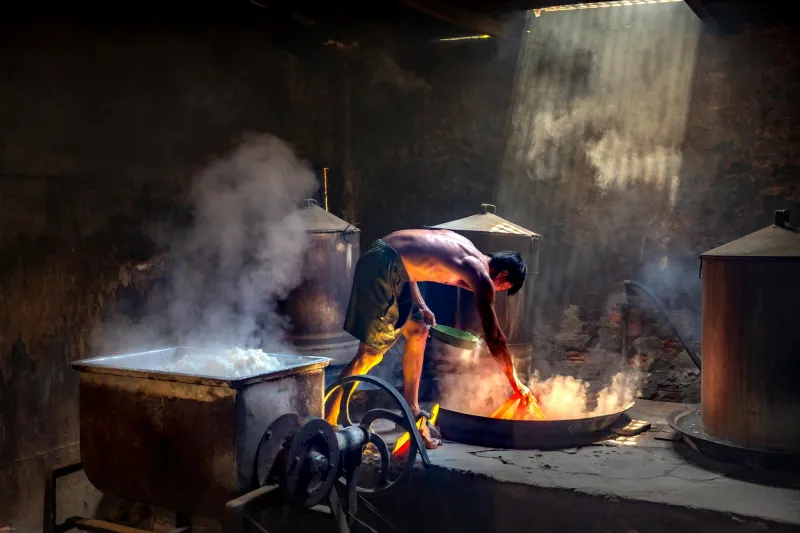
The problem was contamination. Indigo dye vats were essentially massive fermentation tanks, and any slight change in pH, temperature, or bacterial composition could ruin weeks of work. Dyers developed elaborate rituals around their vats, including prohibiting women from the dye house during menstruation, believing their presence would "sour" the indigo.
The Breakthrough That Saved Blue
The solution came from an unexpected source: German chemists trying to create synthetic alternatives to expensive natural indigo. In 1865, Adolf von Baeyer began studying indigo's molecular structure, not to improve the dyeing process but to recreate indigo artificially.
 Photo: Adolf von Baeyer, via i.pinimg.com
Baeyer's research revealed that indigo's instability came from its sensitivity to alkaline conditions. Natural indigo processing used fermented plant matter that created wildly inconsistent pH levels. By controlling alkalinity and adding precise amounts of sodium hydrosulfite, dyers could make indigo behave predictably.
The breakthrough came in 1878, when Baeyer's student Heinrich Caro developed a standardized indigo reduction process that worked consistently. Suddenly, the devil's dye became as reliable as any other colorant.
Why Blue Became the Color of Work
The timing of indigo's stabilization coincided perfectly with America's industrial expansion. Railroad workers, miners, and factory employees needed durable clothing that could hide dirt and survive harsh washing. Indigo-dyed denim checked every box: it was dark enough to camouflage stains, the dye process made fabric incredibly strong, and the blue color was distinctive enough to signal working-class identity.
More importantly, stabilized indigo was economical to produce at industrial scale. Levi Strauss could order thousands of yards of consistently blue denim, knowing each batch would match the last. This reliability allowed jeans manufacturers to build brand recognition around a specific shade of blue.
By 1900, indigo blue had become so associated with American labor that the term "blue collar" emerged naturally from the workplace. White-collar workers wore shirts that showed dirt easily, signaling they performed clean office work. Blue-collar workers wore indigo-dyed garments that hid the grime of physical labor.
The Chemical Legacy in Every Thread
Even today, with dozens of synthetic blue dyes available, denim manufacturers still use indigo for reasons that trace back to those early chemistry problems. The unique way indigo bonds with cotton creates the distinctive fading patterns that make jeans more attractive with age and wear.
Modern indigo dyeing still follows the same basic chemical process discovered in the 1870s. Denim threads are dipped repeatedly in indigo baths, building up layers of dye that wear away gradually over time. This creates the characteristic blue-to-white fade that defines worn jeans.
"We could dye jeans with more stable colorants that wouldn't fade," explains textile chemist Dr. Robert Chen, "but consumers specifically want that indigo fade pattern. It's become part of the product's identity."
The Global Blue Standard
The standardization of indigo dyeing accidentally created one of the world's most universal fashion items. Because the chemical process was consistent, denim manufacturers anywhere could produce fabric that matched American work pants. This allowed jeans to spread globally while maintaining their distinctive appearance.
Today, over 4 billion pairs of jeans are sold worldwide annually, and nearly all use indigo dye. The global indigo market is worth $8.5 billion, with most production concentrated in countries that have perfected the chemical processes pioneered in the 1870s.
Japanese denim manufacturers have elevated indigo dyeing to an art form, using traditional fermentation methods alongside modern chemistry to create premium denim that can cost over $300 per pair. These artisanal jeans still use the same basic indigo chemistry that plagued 19th-century dyers.
The Color That Defined a Culture
The devil's dye that once terrorized textile workers became the foundation of American casual fashion. The blue in blue jeans isn't just a color choice—it's the result of centuries of chemical problem-solving that happened to coincide with America's industrial growth.
Every pair of jeans carries the molecular fingerprint of that original dye crisis. The way indigo fades, the reason jeans turn lighter blue with washing, and even the slight variations in color between different pairs all trace back to the unstable chemistry that early dyers struggled to control.
When Levi Strauss chose indigo for his work pants, he probably thought he was just picking a practical dark color. He couldn't have known he was selecting the dye that would become synonymous with American style, rebellion, and youth culture worldwide. The devil's dye had finally found its calling.