The Broken Soda Machine That Quietly Rewired Who Actually Owns Your Phone
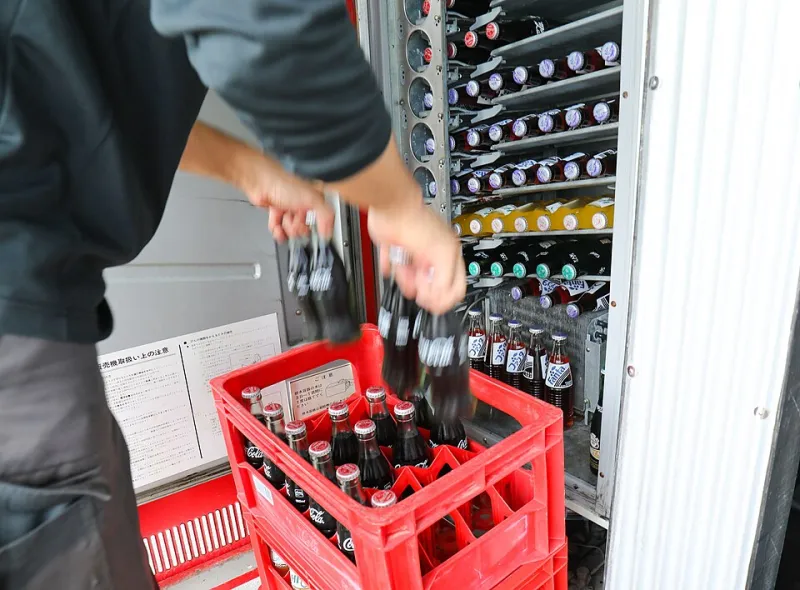
Photo: Sean Kimmons, U.S. Army Garrison Japan Public Affairs, Public domain, via Wikimedia Commons
Somewhere in your home right now, a device you legally own is running software you didn't install, updated by a company you can't call, changing behavior you may not have noticed. Your smartphone does it. Your car almost certainly does it. Your smart thermostat, your streaming stick, your wireless earbuds — all of them receive instructions from somewhere else, adjusting what they do and how they work, often while you're asleep.
This arrangement is so normal now that most Americans never question it. But it had to start somewhere. And the place it started is genuinely unexpected: a row of soda machines in the early 1970s, and an engineer who was tired of driving across town to fix them.
The Problem With Machines That Break Far Away
By the late 1960s, vending machines had become a fixture of American commercial life. Offices, factories, hospitals, and schools all had them. The companies that owned and serviced these machines faced a persistent operational headache: when a machine malfunctioned, the only way to diagnose the problem was to physically send a technician to look at it. Often the technician would arrive, discover the issue was a simple calibration error or a jammed coin mechanism, fix it in ten minutes, and drive back — having spent hours in transit for a problem that required almost no actual repair time.
In the early 1970s, engineers at several large vending and food service companies began experimenting with a solution. The idea was to connect machines to a central monitoring system through telephone lines — early, slow, and expensive telephone lines — that could transmit basic diagnostic data back to a headquarters. If a machine reported a temperature anomaly or a payment error, a technician could potentially identify the problem before ever leaving the building.
This was already a meaningful step. But the more ambitious version of the idea went further: could you also push instructions back to the machine? Could you adjust its settings, reset its software state, or update its operating parameters remotely, without anyone touching it?
Pushing Code Backward Through a Phone Line
The engineers who cracked this in the early 1970s weren't working in Silicon Valley. They were largely industrial engineers and telecommunications specialists, working on what the industry called telemetry systems — the same broad category of technology used to monitor oil pipelines and track weather stations. The application to consumer-facing machines was unglamorous and practical.
The system they developed was crude by any modern standard. Machines communicated through acoustic couplers — devices that physically clamped onto telephone handsets and converted data into audio tones. Transmission speeds were glacially slow. The "updates" being pushed were simple: adjust a price, reset a counter, change a temperature threshold. Nobody was rewriting complex software. The machines barely had complex software to rewrite.
But the conceptual architecture was exactly what would eventually govern every smartphone update, every car firmware patch, and every security fix pushed silently to a connected appliance. The logic was identical: a device in the field, owned by someone else, receiving behavioral instructions from a remote source without requiring physical intervention.
From Soda Machines to Silicon Valley
The technology didn't leap immediately from vending machines to consumer electronics. It migrated slowly, through industrial and military applications first. Remote telemetry systems became standard in aerospace during the 1970s and 1980s. Banking networks used early versions of the same logic to push software updates to ATMs. The cable television industry developed its own variation to activate or deactivate set-top boxes from a central office.
By the time the internet made high-speed remote communication cheap and universal, the infrastructure concept was already well established. What changed in the 1990s and 2000s wasn't the idea — it was the bandwidth and the reach. Suddenly, the same logic that had been used to recalibrate a soda machine's coin mechanism could be applied to millions of devices simultaneously, across every product category imaginable.
The term "over-the-air update" entered mainstream consumer vocabulary sometime around the mid-2000s, when smartphone manufacturers began routinely pushing operating system changes to devices already in users' hands. Most people received this as a convenience. A few noticed something slightly more complicated was happening.
You Own the Hardware. The Behavior Is On Loan.
Here's where the accidental origin of all this starts to carry some real weight. When that industrial engineer figured out how to push a price change to a soda machine in 1972, the machine belonged to his company. The update was an owner modifying their own property. The relationship was clean.
The same relationship does not apply when Apple updates the software on an iPhone you purchased, or when a car manufacturer pushes a firmware change that adjusts the performance characteristics of a vehicle sitting in your driveway. In those cases, a company is modifying the behavior of something you paid for and legally own — and in a growing number of documented cases, those updates have removed features, changed functionality, or introduced limitations that didn't exist at the time of purchase.
Tesla has used over-the-air updates to temporarily unlock battery range during natural disasters — and to re-lock it afterward. Printer manufacturers have pushed updates that disabled third-party ink cartridges. Smart home device makers have issued updates that rendered older hardware incompatible with current systems.
The legal and philosophical questions this raises are significant and largely unresolved. Consumer advocates have spent the better part of a decade arguing that the right to repair — and the right to not be updated — should be protected. Manufacturers argue that updates are necessary for security and functionality.
Both sides are having a genuinely important argument. But the argument itself only exists because an engineer in the early 1970s needed a cheaper way to fix a broken soda machine.
The most consequential technologies rarely announce themselves. Sometimes they show up disguised as a maintenance shortcut — and spend the next fifty years quietly rearranging who's in charge.